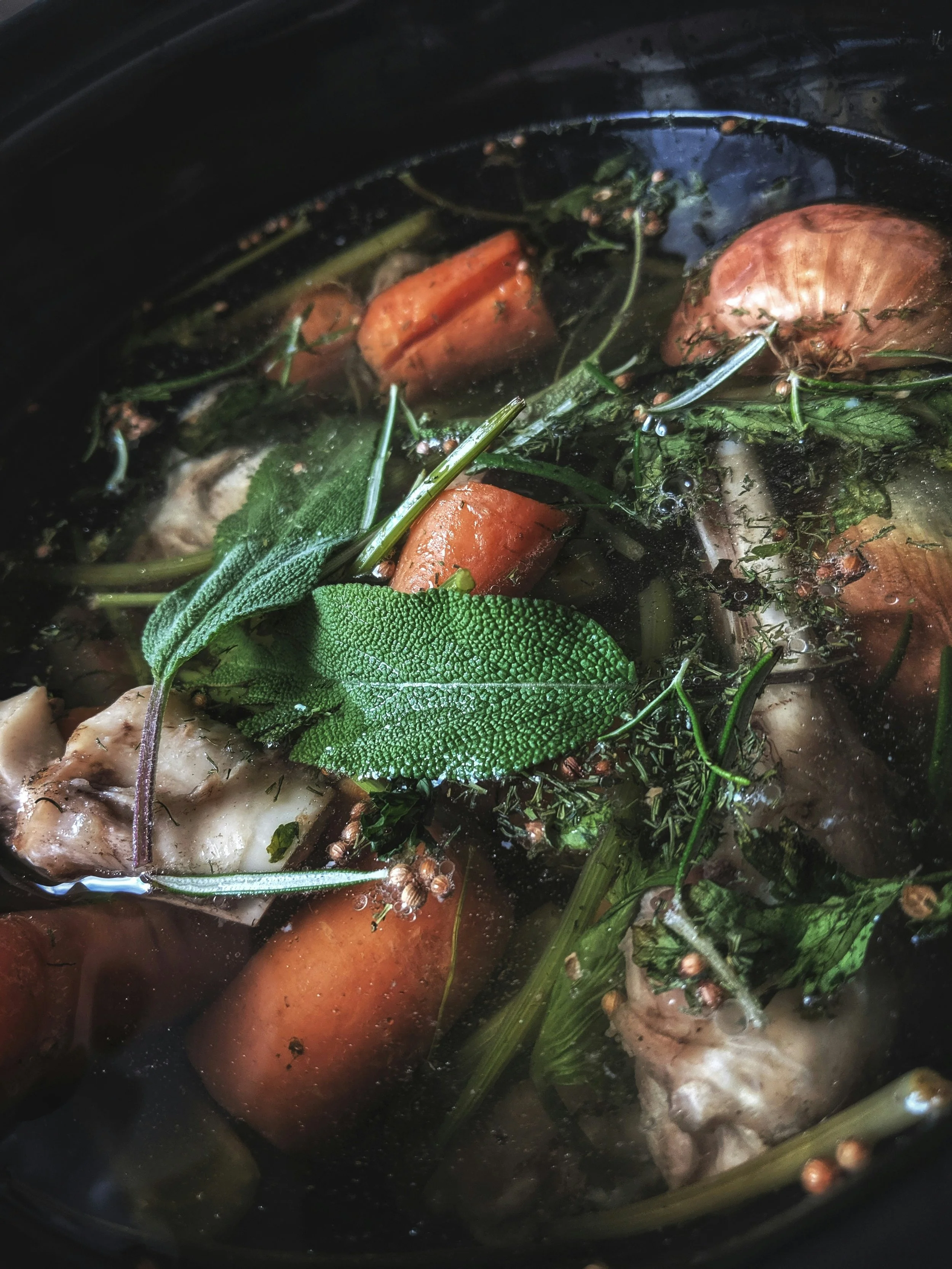
In cooking school, we learned to make broths and stocks in the classic french manner. Roasting the bones and vegetables first, simmering on the stovetop for 8 hours or more, continually tweaking the temperature to walk the line between boiling and no action on the surface.
If you are spending your entire day in the kitchen, this works. It’s the first thing you do when your shift starts and the last thing you do before you go home.
Is there any wonder why most of us don’t make stock at home?
As is true of many chefs, I am sort of a recovering snob when it comes to kitchen gadgets.
Garlic presses, special machines that only do one task. I don’t like kitchen clutter and I like my gear to my multifaceted.
I poo-pooed the instapot until our family decided to live and travel on a sailboat for 2 years. Suddenly, faced with cooking in the tropics, the idea of a machine that could be vented outside to keep our galley cool became very appealing. Plus, using electricity from our solar panels, as opposed to propane from our stove, made a lot more sense. We had American propane tanks, so we could only replace them on islands with the same system. If you run out while on a European island, it might be a good while before you can refill. We lived a lot off rice and beans those years as provisioning was a full body activity and you never knew what you’d find on an island. Beans also take a lot of time to cook and some babysitting, and they heat the whole kitchen up.
Enter: The Instapot.
The Instapot on a boat was life changing. Note: it’s not as suitable for monohulls as it is for catamarans, and I only used it when we were safely anchored.
When we returned home to N. California, it had earned a top position in my kitchen. I use it to steam beets, to can jams and salsa, to cook artichokes, beans and to make bone broth.
Instapot bone broth is not as good as preparing a stock over the stove for 8 hours, but the high pressure environment draws nutrients out of the bones that would take forever. It is, however, infinitely better than using water or boxed broth. I also don’t bother roasting the bones and vegetables most days, becaused lower standards as a family cook = getting it done.
I have a gallon ziplock bag in my freezer where I collect vegetable scraps: leek tops, onion and garlic skins, carrot ends, celery butts. If I buy a rotissserie chicken, I’ll freeze the carcass as well. Come soup season, I’m making broth once a week. I store it in these paper cups in the freezer, which make for easy defrosting. When I run out of carcasses I start buying chicken bones.
Bone broth is an incredibly nourishing food, particularly when it comes to gut health. And the flavor elevates your soups and stews. People can taste the difference- it’s so rare to have soup made the old way these days.
That was a very long introduction to a very short recipe!
Ingredients
Chicken bones or carcass
Onion skins or ½ onion sliced
1 carrot cut up, or carrot scraps
2 stalks celery
2 garlic cloves with skin
5 whole peppercorns
1 dried chile de arbol
2 bay leaves
1 tsp Apple Cider Vinegar
Instructions
1) Put everything in the Instapot and cover with water just below the fill line. Set to high pressure for 1 hour and 15 minutes. I don’t salt it- I usually just salt whatever I’m making it with.
2) Cool, strain and store in smaller batches in the freezer.