Meal Planning for People Who Don’t Want To Meal Plan
As a habitually heady person, I learned something valuable a few years back: let your body have an experience before your mind decides what to make of it.
People have been asking me for my formula for years. I’m finally starting to write about it, and organize it in ways that are useful to others.
I resisted meal planning forever, and I see that same resistance come up for most of my clients. Few people want to do this. Couples and single folks can get away with winging it and staying sane, but if you’re feeding a family without a plan, you’re probably wasting a lot of time and money for subpar meals and more stress.
In my life before parenthood, I loved to peruse the farmer’s market or grocery store, cooking whatever was in season or whatever I was craving in the moment. I shine when I cook that way, and I imagine I’ll return to it someday when our nest is empty. But feeding a family is tedious and relentless, even if you love cooking, even if you have experience as a line cook banging out 300 to 400 dinners a night. Cooking for a family is practically a commercial enterprise you do for free, and most of us had no idea what we were signing up for. This is coming from someone who loves to cook, though I don’t always love cooking for my family. So I really feel those of you who don’t love it.
Kids will have a big snack and then not eat the dinner you made. Or they won’t like it, even if they devoured the same meal two weeks ago. Now that mine are teens and tweens, there are a dozen activities a week between all of us, so the odds we’re even sitting down to eat together on a given night are pretty low, which is a heartbreak of mine.
Part of my resistance was resisting reality. If I could wave a magic wand and get the outer world to comply, dinnertime would be sacred and nothing could be scheduled during it. When it comes to rituals around food, I sometimes feel I’m meant to live in Europe more than the States, somewhere mealtime is the center attraction. There’s an Ayurvedic belief about the life force of food that’s just been prepared, and I truly believe it. But that philosophy is built around cultures where women spend most of their days in the kitchen. Compromises are required for sanity’s sake, and once you add in everything modern nutrition asks of us, it’s a balancing act to hit all the notes.
Resisting reality is a great way to miss the opportunities the present provides. Here’s what meal planning has actually brought me:
Knowing there’s always food around, food I want to eat, and food that’s good for me.
Feeling a lot less resentful when no one shows up for dinner, or shows up without an appetite, because I have a system that streamlines my time and works with our current reality instead of against it.
Spending a lot less time thinking about and preparing food.
Spending less money and eating better.
The spontaneity that had me resisting meal planning for so long simply isn’t available in this season of life. I was holding onto a version of my past that isn’t currently an option, and letting go of it made room for something that actually works.
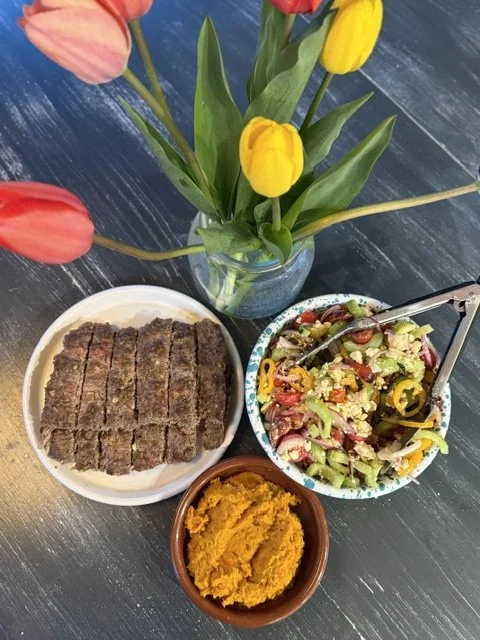
Sheet Pan Kebs, Salad with Cucumber and Feta, Winter Squash with Cultured Butter & Marash Chili
The Overall Approach
Each week, I cook to a different theme, usually by culture: Japanese, Mexican, American, Latin American, Pan-Asian, Middle Eastern, Indian, and so on. I follow about a dozen menus which I rotate, modifying slightly depending on the season. On Sundays, I prep for the week. I premake salads for our lunches, marinate meats, and prep vegetables to make weeknight cooking easier. Then I cook three weeknights a week, Monday, Wednesday, and Friday, making extras for leftovers the following night’s dinner.
The reasons I cook this way are threefold:
It minimizes ingredient costs. Cooking to one cuisine means I’m more likely to need two recipes that each call for half a bunch of cilantro, instead of buying a full bunch for one dish and watching the rest go bad.
It ensures leftovers actually get eaten. When the leftovers from different meals pair well together, nothing sits in the fridge going to waste.
It’s fun. It’s more interesting for me, and it pushes me to try new recipes instead of falling back on the same five dinners.
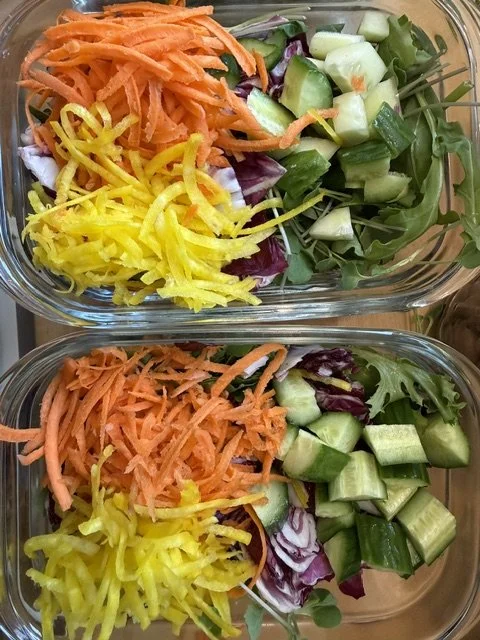
Weekly Salad Prep. Orange Carrots, Yellow Beets, Purple Radicchio. I keep the dressing & any cooked vegetables/proteins separate
The Nitty Gritty
This meal plan is trying to do a lot. There are culinary standards to uphold as well as nutritional ones. I aim to make half of each plate non-starchy vegetables, to eat 30 to 40 different plant foods each week, and to eat 90 grams of protein a day. Barring healing diet protocols that call for a very specific diet for a set period of time, I ask many of my clients to aim for the same.
Here’s how I do it:
I prepare four proteins a week: three for dinner, one for lunch.
I prepare two to three vegetable side dishes and one starch per week.
I batch prep salads for lunch and make one big mason jar of dressing for the week.
I also make the dog’s food, which is slightly insane, I know. I am ridiculously proud of how soft and shiny her coat is, in part because she eats sardines.
We mostly eat the same lunch every day and save leftovers for the following night’s dinner. Many of you will want more starch - adding it in is easy. Because metabolic health is my weakest area, I have to be mindful of my complex carbohydrate intake, so I keep them to a minimum. And the kids eat so many carbs elsewhere that I find it’s good for everyone to go light at home. It’s having non-starchy foods around that requires the most intention.
The Rotation
Here’s a sample of the menus I rotate through:
Japanese — Glazed salmon, skirt steak, Japanese sweet potatoes with miso butter, make-your-own poke bowls
Middle Eastern — Sheet pan kebab, chicken shawarma in lettuce cups, zucchini turkey burgers with yogurt sumac sauce, cucumber tomato and feta salad
Mexican — Carne asada, Rancho Gordo beans, chicken tortilla soup, Mexican street corn, Mexican roasted zucchini
Italian — Crispy chicken with lemon and capers, turkey bolognese with spaghetti squash, fish with green olive salsa verde, roasted green beans with garlic
American — Salmon burgers, grilled chicken, smashed potatoes, oven roasted cauliflower, lemony garlic kale salad
Thai — Turkey larb in lettuce cups, chicken satay, spring rolls with mango and tofu
Pan-Asian — Asian dumpling tacos, napa cabbage and cold ramen salad, Indonesian ginger chicken, broccoli with garlic and soy
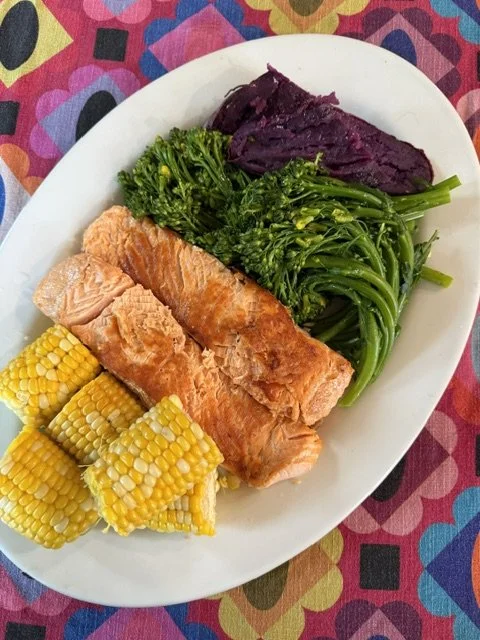
Eating the Rainbow: Trout, Purple Potatoes, Corn & Purple Broccolini
Sunday, Mapped Out
I generally don’t shop the same day I cook. I’ll either shop on Friday or place a grocery order for pickup Saturday, so the ingredients are ready to go on the Sunday morning I do prep.
Here’s roughly how my two to three hours go:
First 30 minutes: wash and chop all produce for the week’s salads and side dishes in one pass. Assemble lunch salads.
Next 45 minutes: get proteins marinating, season anything going into the fridge for Monday and Wednesday’s cook.
Next 30 minutes: make salad dressing.
Last 30 to 45 minutes: cook anything that holds well, a starch, a roasted vegetable, cleaning as I go so I’m not facing a sink of dishes come Monday. I’ll sometimes make that night’s dinner too, while I’m at it.
I recognize that giving up weekend time to prep for the week isn’t for everyone. You have to really value eating well, or have a health issue that demands it. As far as I’m concerned, food is life, and eating well is one of the greatest telltales of a life well lived.
In the coming weeks, I’ll be sharing more recipes and full meal plans on my newsletter. Sign up here if you’d like to follow along.
So where is your resistance? I’d love to hear in the comments. I’m curious to understand what gets in the way for each of us.